Understanding Kosher Standards
Not every customer or market requires the same type of kosher certification. The appropriate standard can depend on the product, ingredients, production process, intended customer and target market.
Fidelity Kosher helps manufacturers identify the certification requirements relevant to their particular commercial situation.

Standard kosher certification
For many products and markets, regular kosher certification is appropriate.
Certification involves review of the relevant ingredients and production processes, the evaluation of contamination risks, the evaluation of available documentation and safeguards, and the establishment of suitable supervision and production requirements.
Certificates are usually issued for the duration of one year, though material changes in ingredients or processes may impact the validity of a certificate even after issuance.

Dairy standards
Dairy products whose certification begins with the reception of the milk at the dairy processing plant is called chalav stam.
Traditionally milk was only considered kosher if there was rabbinic supervision from the dairy farm to the final product. This standard is called chalav yisrael, and is a form of enhanced certification. Innovations in government standards over the course of the 20th century have received a mixed reception in the kosher community, which is why it is so important to know the market you aim to serve.

Mehadrin / enhanced standards
Some customers and markets require additional kosher standards beyond those used for regular kosher certification. These are often described as Mehadrin standards.
The precise requirements can vary according to the product category, market and certifying organization. There is therefore no definite single universal industrial specification called “Mehadrin.” Where enhanced standards are required, Fidelity Kosher can assess the relevant product and production requirements and establish an appropriate certification program.

Yashan
Cereal and cereal products exported to Israel must meet the yashan requirement. This entails obtaining documentation on the origin of grain and when it was drilled, so as to ascertain that they were drilled before a certain cutoff date connected to the Jewish holiday of Passover.
A variety of methods are employed to support downstream manufacturers through this process. For companies sourcing raw grains, this process involves obtaining representative drilling passports, as well as perusing other agriculture information sources.
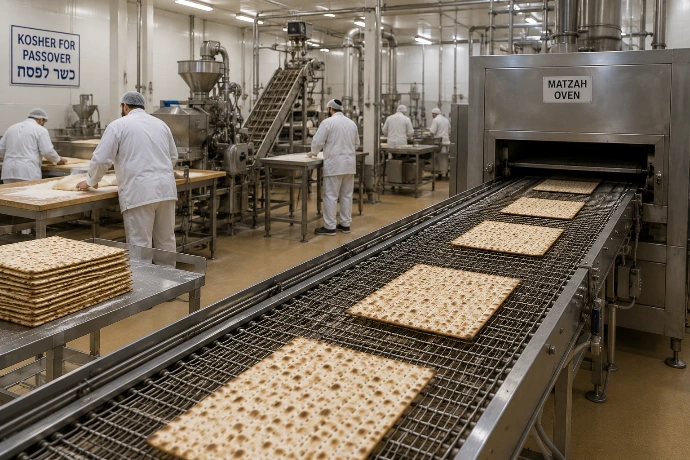
Passover
Passover (Pesach) involves additional kosher requirements, particularly concerning ingredients and production involving grain and grain derivatives.
A product that is kosher throughout the year is therefore not automatically kosher for Passover.
Passover certification requires a separate assessment of ingredients, processing aids, equipment and production arrangements. Depending on the product and facility, special production preparation and supervision may be required.
Fidelity Kosher can assess whether Passover certification is feasible and what would be required.

Customer-specified certification
When your customer specifies a particular kosher agency
Sometimes the relevant question is not simply whether a product is kosher. A customer may require certification that it recognizes or may specifically request a particular kosher certification organization.
If this happens, please tell us before beginning the certification process.
Fidelity Kosher maintains professional relationships with established kosher certification organizations and can help you understand the customer's requirement. Where appropriate, we can also cooperate with the relevant organization to find a practical certification solution.
Has your customer sent you a kosher specification that you do not understand?
Send us the requirement. We can help you determine what it means for your products and facility.